UX Consultancy London: How Expert UX Consulting Drives B2B Product Growth

What Is a UX Consultancy and How Is It Different from a UX Agency?
The terms UX consultancy and UX agency are often used interchangeably, but they describe subtly different service models. A UX consultancy London typically provides strategic advisory — diagnosis, prioritisation, and direction — with execution as a secondary or optional component. A UX agency is more commonly contracted to produce deliverables: research reports, design prototypes, production-ready Figma files. In practice, the best providers do both, but it is worth understanding which mode of engagement your product situation actually requires before you brief an external partner.
If your product team has execution capacity but lacks strategic clarity about which UX problems to solve first, a consultancy model — focused on evidence gathering, opportunity sizing, and roadmap sequencing — will serve you better than commissioning a design deliverable without a clear brief. If you have a well-defined brief and need skilled execution, an agency model is appropriate. Many London-based UX consultancies, including our own, structure engagements to begin with consultancy-style discovery and transition into agency-style delivery once the strategic foundation is established.
What a UX Consultancy London Engagement Covers
UX Audit and Diagnostic
The starting point for most UX consultancy London engagements is a structured audit of the current product experience. A skilled consultant reviews the product against established usability heuristics, maps user journeys through core tasks, identifies friction points in the conversion funnel, and cross-references design observations against analytics data to understand where users are actually dropping off. The output is not a list of design opinions — it is a ranked inventory of UX problems, each assessed for severity and estimated commercial impact.
This audit-first approach is what separates a genuine UX consultancy from a design agency that starts by producing wireframes. Without a diagnostic foundation, design decisions are driven by stakeholder preference and aesthetic taste rather than evidence. The most common outcome of assumption-based design is a beautifully produced set of screens that does not move the metrics the project was intended to improve. Our UX audit service forms the first phase of most consultancy engagements.
User Research and Insight Synthesis
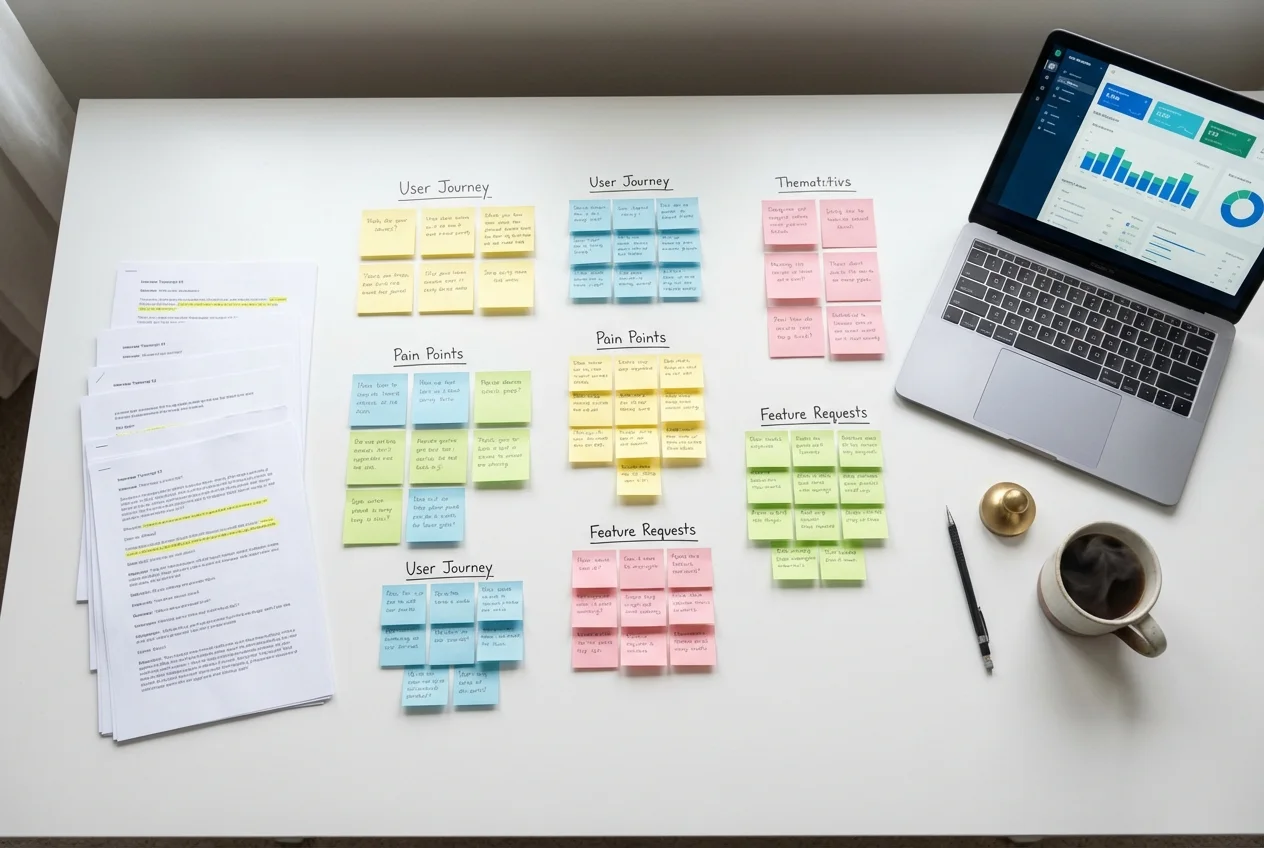
A London UX consultancy supplements the product audit with structured user research — interviews, usability sessions, and analytics walkthroughs — that builds a validated picture of how real users think about, navigate, and complete tasks within the product. The research methodology is selected based on the specific questions the audit raised: if the audit reveals that users abandon a particular flow, usability testing identifies the specific moment of failure; if analytics shows high bounce rates on a landing page, diary studies or A/B tests clarify whether the problem is messaging, navigation, or technical performance.
Insight synthesis — turning raw research data into actionable product decisions — is the core competency of a skilled UX consulting team. The deliverable is not a transcript of interview recordings; it is a structured synthesis that connects user behaviour patterns to specific product improvements, each with a rationale that can be presented to engineering and commercial leadership. For a detailed view of our research methodology, see our UX research service page.
UX Strategy and Roadmap Development
The output of audit and research work is a UX strategy: a prioritised roadmap of improvements ordered by estimated commercial impact, implementation complexity, and strategic fit with the product vision. A good UX strategy does not produce an exhaustive backlog — it identifies the three to five interventions most likely to move the metrics that matter most to the business, and sequences them in a way that allows the product team to build momentum and measure attribution.
For B2B SaaS products, the UX strategy typically focuses on three funnel stages: activation (getting trial users to first value), retention (maintaining daily engagement among activated users), and expansion (driving seat expansion and plan upgrades). Each stage has different research inputs, different design levers, and different measurement timelines. A specialist UX consultancy London team with B2B SaaS experience will be able to segment the strategy by funnel stage and connect each initiative to the specific metric it is expected to move.
When to Commission a UX Consultancy London vs. Hire In-House
The Case for External UX Consulting
External UX consulting provides two things that internal teams struggle to provide for themselves: independence and specialised experience. Independence matters because internal teams are embedded in organisational assumptions that have accumulated over months or years — assumptions about user behaviour, about what features are important, and about what the product is fundamentally for. A UX consultant London sees the product as an informed outsider and can surface the assumptions that have become invisible to the internal team.
Specialised experience matters because UX consulting at a high level requires a breadth of exposure — to different product types, different user populations, different failure modes — that is difficult to accumulate in a single-product organisation. A consultant who has run activation research for fifteen B2B SaaS products knows which patterns of failure are common, which interventions tend to work, and which expensive-seeming improvements rarely move the needle. That pattern recognition accelerates the diagnostic process significantly.
The Case for In-House UX Capability
Internal UX teams have advantages that external consultants cannot replicate: continuous context about the product roadmap, relationships with engineering and product management, and the ability to integrate UX thinking into daily sprint decisions rather than periodic project deliverables. For organisations shipping product changes on a weekly cadence, in-house UX capability produces faster feedback loops than episodic consultancy engagements.
The most effective model for most London B2B organisations is a hybrid: a small internal UX team responsible for sprint-aligned execution, supplemented by periodic external consultancy for strategic diagnosis, research methodology expertise, or design quality review. This structure combines the context advantages of in-house with the independence and specialist experience advantages of external. Our guide to UX agency vs in-house designer covers this decision framework in detail for London startups and scale-ups.
What to Expect from UX Consulting London Costs
UX consultancy London pricing varies substantially depending on the scope and seniority level of the engagement. Here are the realistic ranges for 2026:
Advisory Day Rates
Senior UX consultant London day rates range from £800 to £2,000 per day, depending on experience level and specialisation. Consultants with deep B2B SaaS or regulated-industry experience command rates at the upper end. Day-rate engagements work well for short diagnostic sprints, stakeholder workshops, and design review sessions where the deliverable is expert input rather than production assets.
Fixed-Scope Consultancy Engagements
Most structured UX consultancy London projects — audit plus research plus strategy — are scoped on a fixed-fee basis ranging from £12,000 to £45,000, depending on product complexity, research scope, and the depth of the strategic output required. Fixed-fee engagements provide budget certainty and are appropriate when the scope can be defined upfront. Discovery phases are typically priced separately (£3,000 to £8,000) as a low-risk entry point that allows both parties to evaluate the working relationship before committing to full engagement scope.
Ongoing Retainer Models
For organisations that need continuous UX consultancy input — strategic advisory, design quality review, and research oversight on a rolling basis — monthly retainer arrangements typically range from £5,000 to £15,000 per month depending on the hours commitment and seniority level. Retainer models work best for Series A+ B2B SaaS companies where UX decisions are frequent, complex, and commercially significant.
Evaluating a UX Consultancy London: Five Questions That Matter
1. What is your diagnostic methodology?
A credible UX consultancy London team will be able to describe, in specific terms, how they approach the initial audit: what frameworks they apply, how they prioritise findings, and how they estimate commercial impact. Vague answers about "user-centred design" without a concrete audit methodology indicate limited consultancy experience.
2. How do you connect design recommendations to business metrics?
Every recommendation from a UX consulting London engagement should be connected to a specific, measurable business outcome — conversion rate, activation rate, churn, support volume, or time-to-value. If a consultant cannot describe the metric their recommendation will move, the recommendation is not trustworthy.
3. Can you show a case study where your consultancy moved a commercial metric?
Ask for before-and-after data on a specific business metric from a previous B2B engagement. Consultancies that have delivered measurable impact will provide this readily. Those that cannot may have produced high-quality design deliverables without tracking commercial attribution.
4. How do you handle situations where research contradicts stakeholder assumptions?
This question reveals whether the consultant is genuinely independent or whether they tend to validate existing stakeholder views. Effective UX consultants are comfortable presenting findings that challenge internal assumptions and have a structured approach to facilitating the stakeholder conversations that follow.
5. What does your engagement model look like after the initial consultancy phase?
The most common failure mode of UX consultancy engagements is the insight gap — research findings that are understood and agreed upon during the consultancy phase but never implemented because there is no ongoing mechanism to connect the findings to the product team's work. Consultancies that offer a clear path from strategic insight to implementation support, or who design handoffs that allow the internal team to execute confidently, tend to deliver better commercial outcomes than those who produce reports without implementation support.
UX Consultancy London for Specific Sectors
Fintech UX Consultancy London
Financial services products face UX challenges that are specific to the regulatory environment: mandatory disclosure journeys that must be navigated without obscuring the information that regulations require, security authentication flows that must balance compliance with usability, and data-dense interfaces where cognitive load management is critical to safe and accurate use. A specialist UX consultancy London with fintech experience understands these constraints and designs within them — rather than treating regulatory requirements as obstacles to good UX.
SaaS UX Consultancy London
B2B SaaS products require UX consultancy expertise in multi-role product design, trial activation optimisation, and the specific dynamics of enterprise buying committees. The UX problems that matter most in SaaS are not aesthetic — they are structural: information architectures that do not reflect how multi-role teams actually work, onboarding flows that fail to deliver value within the critical first session, and dashboard interfaces that present data without surfacing the insights that drive decision-making. Our SaaS UX design agency London guide covers these dynamics in depth.
Enterprise UX Consultancy London
Large organisations committing to enterprise UX consultancy engagements need a partner who can operate effectively within complex stakeholder environments: presenting to C-suite audiences, managing multiple functional stakeholders with competing priorities, and translating research findings into governance frameworks that can be embedded into the organisation's product development process. The consultancy deliverable is not just a set of design recommendations — it is the stakeholder alignment architecture that allows those recommendations to be implemented at scale.
Getting Started with UX Consultancy London
The most effective entry point for most B2B organisations is a paid discovery phase: two to three weeks of focused diagnostic work that produces a clear picture of where your product's most significant UX opportunities lie and what it would cost and take to address them. This structure allows you to evaluate the quality of the consultant's thinking before committing to a full engagement, and produces a prioritised opportunity brief that remains useful even if you choose to execute with an internal team.
For organisations that want to understand the strategic landscape before commissioning a full consultancy engagement, our UX strategy service describes how we structure the discovery-to-roadmap process. For a broader view of how London UX agencies approach B2B product challenges, our London UX agency guide covers the full agency selection framework.
When you are ready to discuss your specific product situation, book a free 45-minute UX review. We will assess your current product, identify the two or three UX levers most likely to move your commercial metrics, and provide a clear scope for a consultancy engagement that fits your timeline and budget.
 UX Research
 UX Audit
 UX Strategy