The UX Discovery Process for Enterprise Clients: What to Expect
What Is the UX Discovery Process?
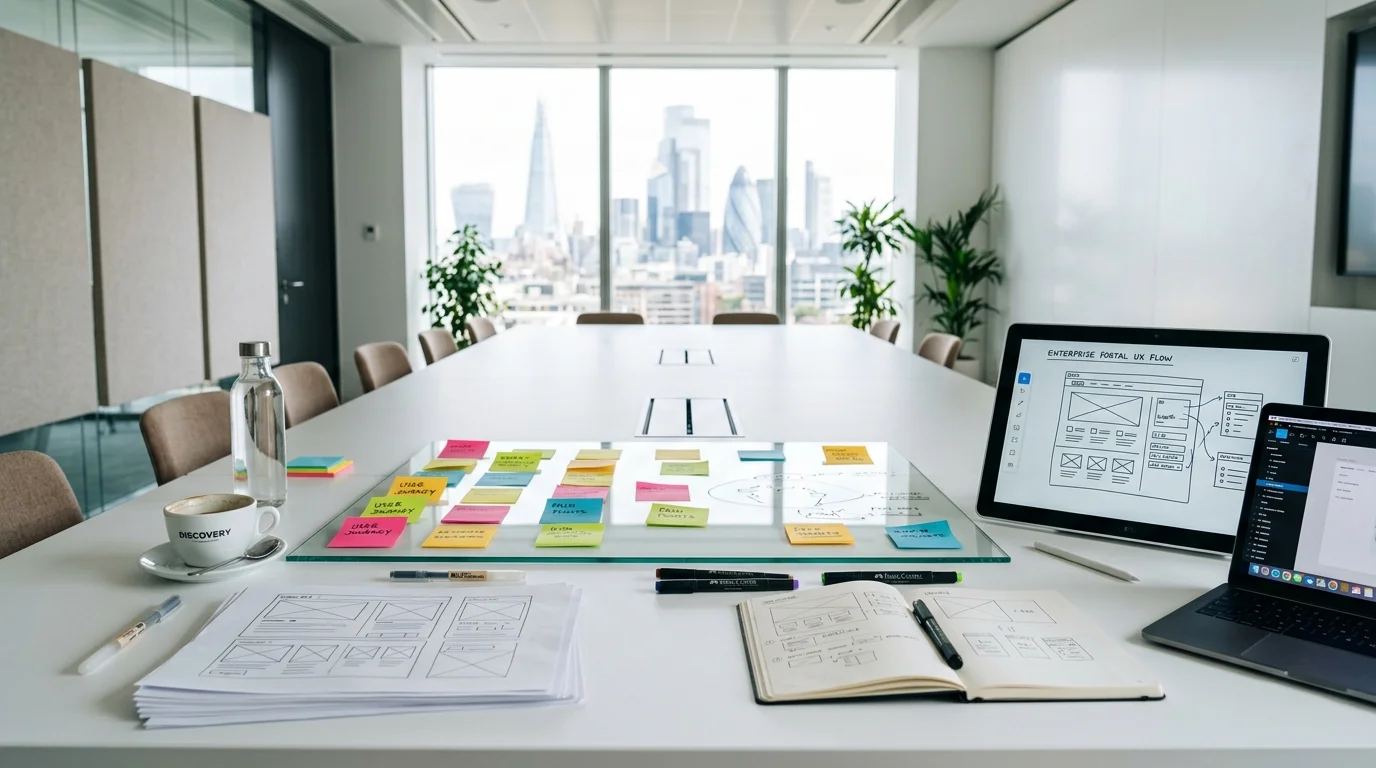
The discovery phase is the foundation of every successful UX project. Before a single pixel is pushed or a wireframe is sketched, a rigorous discovery process ensures that the design work that follows is grounded in evidence — not assumptions. For enterprise clients, this phase is not a luxury; it is a necessity.
At our UX agency in London, we have run discovery programmes for organisations ranging from FTSE 100 corporations to fast-scaling B2B SaaS businesses. The common thread is this: clients who invest properly in discovery consistently achieve better outcomes, faster timelines, and lower total project costs than those who skip straight to design.
Why Enterprise Discovery Is Different
Consumer app discovery and enterprise discovery operate at fundamentally different scales. Enterprise products serve multiple user types — administrators, end users, data analysts, compliance officers — each with distinct needs, mental models, and pain points. Add in legacy systems, regulatory constraints, and multi-departmental stakeholders, and the complexity multiplies rapidly.
A digital UX agency working at enterprise scale must navigate:
- Stakeholder alignment: Dozens of people with competing priorities and different definitions of success.
- Existing system constraints: Legacy architecture and technical debt that shape what is possible.
- Compliance and security requirements: GDPR, ISO 27001, and sector-specific regulations that affect design decisions.
- Change management: Employees who have used the existing system for years and will resist change unless the new design clearly benefits them.
- Multiple user cohorts: Different personas with different workflows, skills, and expectations.
Phase 1: Stakeholder Alignment Workshops
Discovery begins not with users but with stakeholders. Before we speak to a single end user, we run structured workshops with the project sponsors, product owners, IT leads, and department heads who have a stake in the outcome.
What We Cover in Stakeholder Workshops
- Business objectives: What measurable outcomes does the project need to achieve? Reduced support tickets, improved task completion rates, lower training costs?
- Success metrics: How will we know if the project has succeeded? We establish KPIs before design begins so we can measure impact afterwards.
- Assumptions and risks: What do stakeholders believe to be true about their users? Which of those beliefs might be wrong?
- Constraints: Technical, budgetary, timeline, and regulatory constraints that must be respected in the design solution.
- Scope boundaries: What is in scope for this project? What is explicitly out of scope? Misalignment here causes the most common and most costly project failures.
These workshops typically run as two to three half-day sessions. We use facilitation techniques — dot voting, assumption mapping, and priority matrices — that prevent the loudest voice in the room from determining the direction. The output is a stakeholder-validated brief: a shared document that everyone has contributed to and agreed on.
Phase 2: User Research Programme
With stakeholder alignment established, we move to user research. The discovery process UX research phase for enterprise clients is typically multi-method, combining qualitative depth with quantitative scale.
Contextual Interviews
We conduct moderated interviews with representative users — typically eight to twelve participants across key persona groups. Unlike lab-based studies, contextual interviews happen in the user's actual environment: their desk, their workflow, their screen. We observe them performing real tasks with real data in real conditions. This surfaces the workarounds, the frustrations, and the informal practices that no requirements document ever captures.
Task-Based Usability Testing
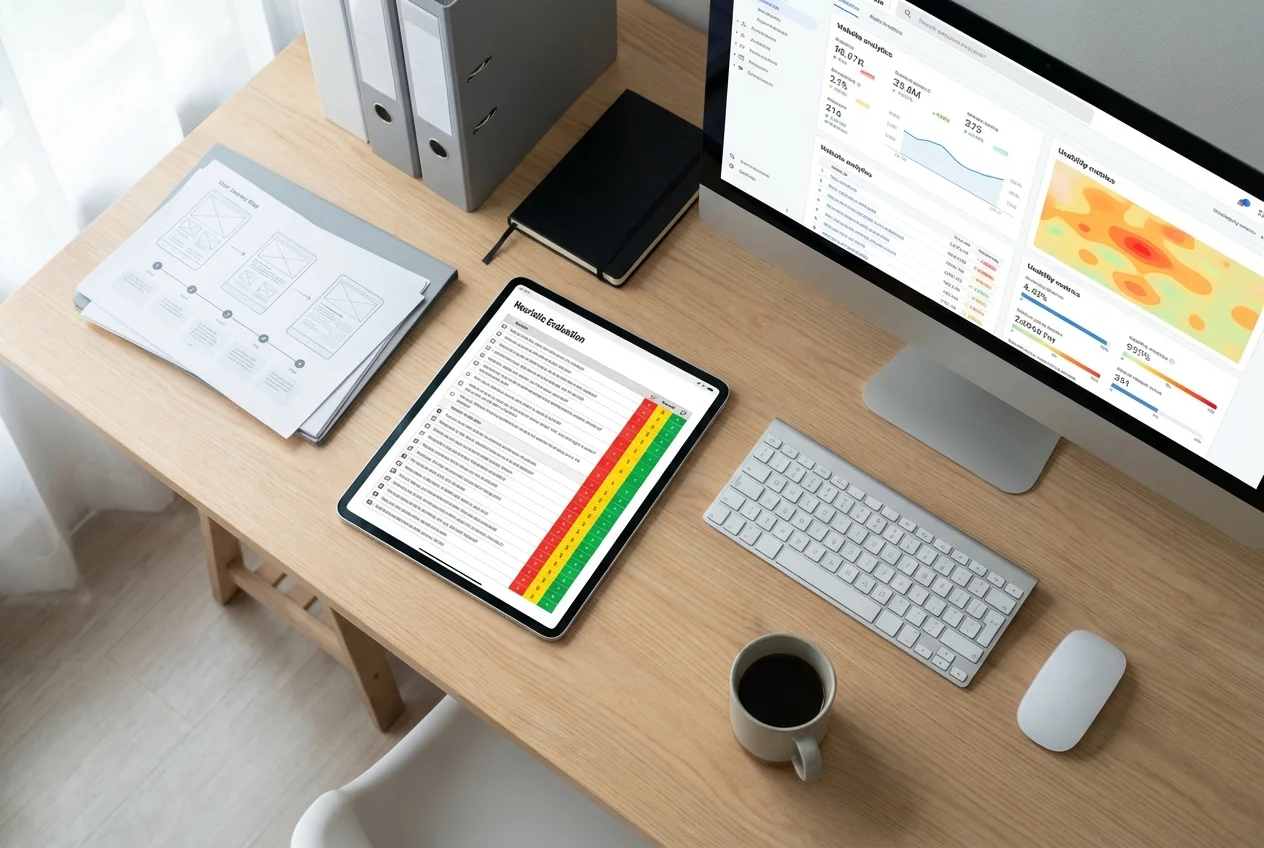
If an existing system is being redesigned, we run structured usability testing on the current product. Participants attempt to complete key tasks while we measure completion rates, error rates, and time-on-task. This creates a quantitative baseline that the new design must surpass — and gives us undeniable evidence of where the current experience is failing.
Surveys and Analytics Review
Qualitative research tells us the "why" behind behaviour; quantitative data tells us the "what" and "how many." We combine interview findings with analytics data — drop-off rates, session recordings, search query analysis — to identify the highest-frequency pain points and prioritise accordingly.
Competitive Benchmarking
We benchmark the client's product against three to five comparators — direct competitors and best-in-class examples from adjacent sectors — to identify where the client's product is lagging and where genuine differentiation opportunities exist.
Phase 3: Synthesis and Insight Generation
Raw research data is not insight. The synthesis phase is where our team transforms hundreds of observations, quotes, and data points into actionable intelligence that can drive design decisions.
Affinity Mapping
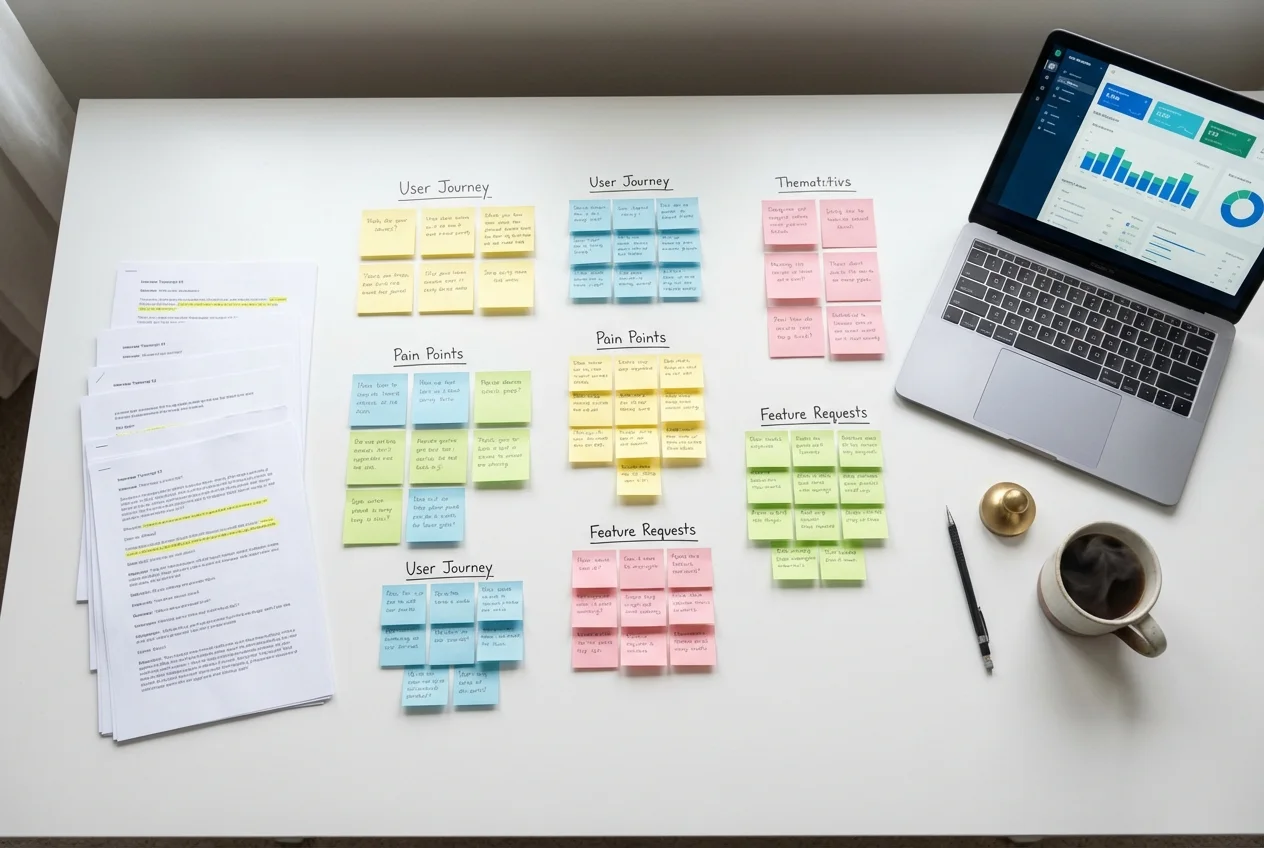
We cluster research observations into themes using affinity mapping — a collaborative technique that ensures every finding is accounted for and patterns emerge from the data rather than being imposed by the analyst. For a typical enterprise discovery programme, this produces forty to eighty distinct themes.
Persona Development
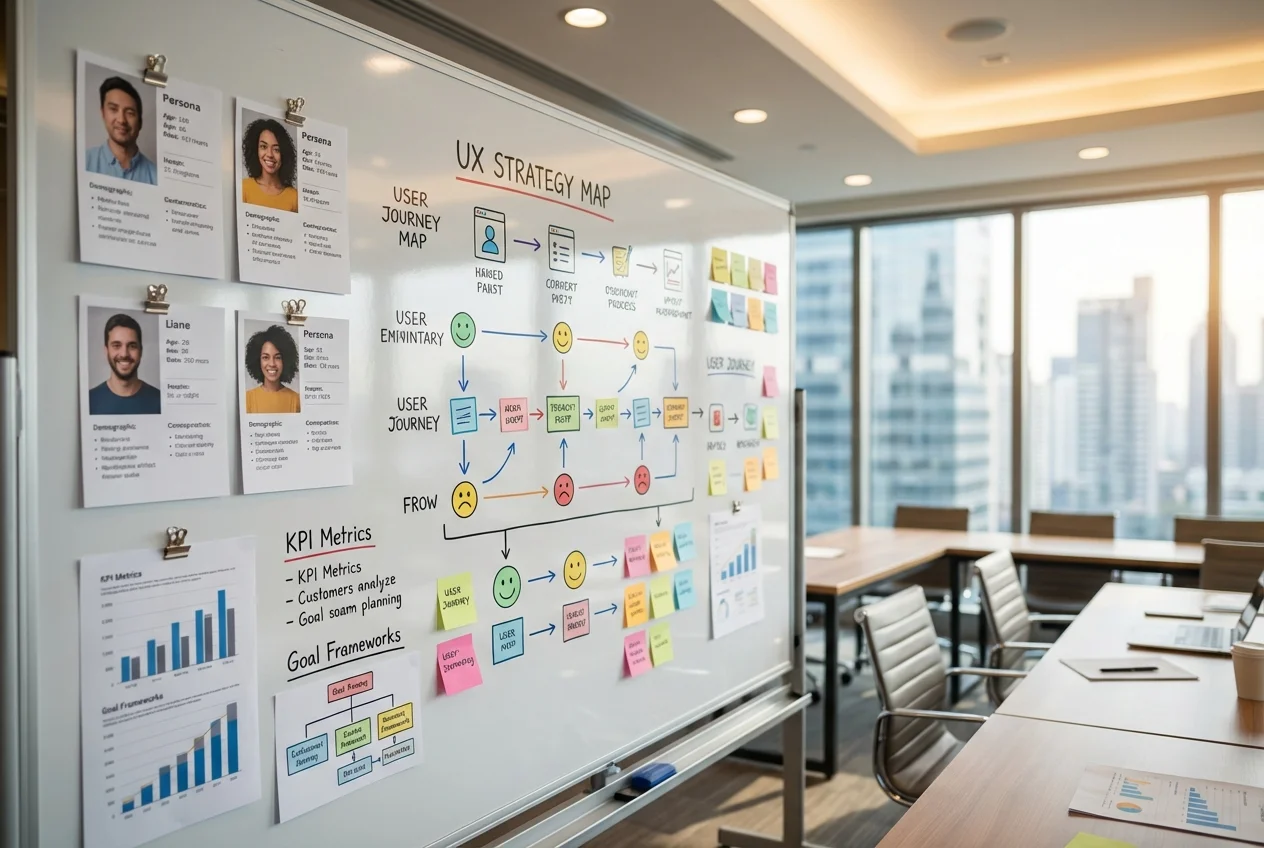
From the research, we develop validated personas — not the demographic sketches often passed off as personas, but evidence-based behavioural archetypes grounded in observed goals, workflows, frustrations, and mental models. Each persona is accompanied by a job-to-be-done statement and a set of design principles specific to that user type.
Experience Mapping
We map the current-state user journey for each primary persona, marking emotional highs and lows, identifying critical failure points, and noting where users rely on workarounds or third-party tools to compensate for system deficiencies. This map becomes the prioritisation tool for the design phase — the areas of deepest red are where we focus first.
Phase 4: Opportunity Framing and Design Direction
The final stage of discovery translates research insight into design direction. We present stakeholders with:
- A prioritised opportunity matrix: Every identified problem ranked by user impact and business value, with effort estimates to resolve each one.
- Design principles: A set of four to six guiding principles derived from the research that will govern all design decisions throughout the project.
- A recommended approach: A clear recommendation on design approach, scope sequencing, and validation strategy for the phases ahead.
- A measurement framework: The KPIs and measurement methods we will use to evaluate the success of the design work post-launch.
How Long Does Discovery Take?
For a mid-sized enterprise project, discovery typically runs three to six weeks. Larger programmes — those involving multiple product lines, global user bases, or extensive regulatory complexity — can run eight to twelve weeks. The timeline is driven by research complexity, not by the agency's billable hours.
Clients sometimes push to shorten the discovery phase to save budget. Our experience is consistent: every week cut from discovery is paid back twice in design revisions and development rework later in the project. A thorough discovery phase is the single highest-ROI investment in the project lifecycle.
What You Receive at the End of Discovery
At the conclusion of a UIDB discovery programme, enterprise clients receive a complete discovery pack:
- Stakeholder-validated project brief
- Full research report with supporting evidence
- Validated user personas with job-to-be-done statements
- Current-state experience maps for each primary persona
- Prioritised opportunity matrix with business impact scores
- Design principles document
- Recommended design approach and sequencing plan
- Measurement framework and KPI definitions
This pack is designed to be boardroom-ready — you can present it to your leadership team, use it to align cross-functional stakeholders, and reference it throughout the design and development phases that follow.
Start Your Discovery Today
If you are planning a major UX project and want to ensure it is built on solid foundations, discovery is where to start. Book a free consultation with our team and we will walk you through exactly what a discovery programme would look like for your specific situation — including timelines, deliverables, and costs. Whether you are a product director at a FTSE 500 company or a Series B startup preparing for scale, our UX agency London team will give you a clear, honest assessment of what your project needs.
 UX Research
 UX Audit
 UX Strategy