Usability Testing Agency London: How Professional User Testing Reduces Engineering Risk

Why Usability Testing Is the Highest-ROI Investment in B2B Product Development
The most expensive design decisions in B2B software are not made when you commission a redesign — they are made when engineering builds something that users cannot or will not use, and the problem is only discovered after the feature ships. IBM's research established that fixing a usability issue after development costs between five and ten times what it costs to fix during the design phase. For enterprise software with six-figure development cycles, this arithmetic is not academic: it is the case for professional usability testing agency London engagement at every major design stage.
Yet most B2B product teams run usability testing intermittently, with small samples, and without the structured methodology that distinguishes diagnostic insight from anecdote. This article explains what a professional user testing agency London actually delivers, when to commission it, and how to evaluate whether an agency has the B2B-specific methodology your product requires.
What a Usability Testing Agency London Actually Does
A specialist usability testing agency London runs structured research sessions with representative users attempting real tasks on your product. The output is not a survey, an analytics report, or a stakeholder opinion poll — it is direct observational evidence of where users succeed, where they fail, and why. This evidence is qualitatively different from internal review because it surfaces the problems your team cannot see: the assumptions built into your design that do not exist in your users' mental models, the terminology that makes sense internally but creates confusion for users, and the interaction patterns that work in demos but fail under daily-use conditions.
A professional ux testing London engagement typically delivers:
- Structured task scenarios: Representative tasks written from the user's goal perspective, not the interface's feature perspective. The difference matters — "find your Q3 invoice" tests differently from "click the Finance tab".
- Think-aloud protocol sessions: Moderated sessions where users verbalise their reasoning as they navigate, surfacing the cognitive gaps between your design intent and user interpretation.
- Observational data beyond the think-aloud: Eye-tracking, click patterns, task completion rates, time-on-task, and error frequencies — quantitative signals that validate and prioritise the qualitative observations.
- Severity-scored issue taxonomy: Every finding is classified by impact (does it block task completion or just slow it?) and frequency (did one user struggle or did seven out of eight?). This severity matrix is what translates research into a product backlog your engineering team can act on.
- Actionable redesign recommendations: The most valuable deliverable — not just a list of problems, but specific design directions for resolving each one, produced by the same specialists who identified the issue.
When to Commission a User Testing Agency London
The short answer: earlier than you think, and more often than you do. The long answer breaks down by product lifecycle stage:
Pre-Build: Prototype Validation
Testing interactive prototypes before engineering starts is the highest-leverage use of a user testing agency London. At this stage, changes cost hours of design time, not weeks of engineering rework. A five-user prototype test run three to four weeks before development starts will surface the navigation architecture problems, the workflow assumptions, and the onboarding friction points that would otherwise survive to production. Our prototyping and wireframing service integrates usability testing as a standard phase rather than an optional add-on.
Post-Build: Launch Readiness Testing
Testing a built product before a major release identifies the issues that can be fixed in a sprint rather than a roadmap item. The cost of a pre-launch usability test is typically recovered in the first support ticket reduction cycle — fewer "how do I..." queries, fewer onboarding failures, fewer support escalations.
Ongoing: Monitoring and Optimisation
For mature products, quarterly usability testing tracks whether the experience is keeping pace with feature additions. Every sprint cycle that adds features without corresponding usability review creates navigation debt — the gradual accumulation of local optimisations that collectively degrade the coherence of the product experience.
Pre-Redesign: Diagnostic Baseline
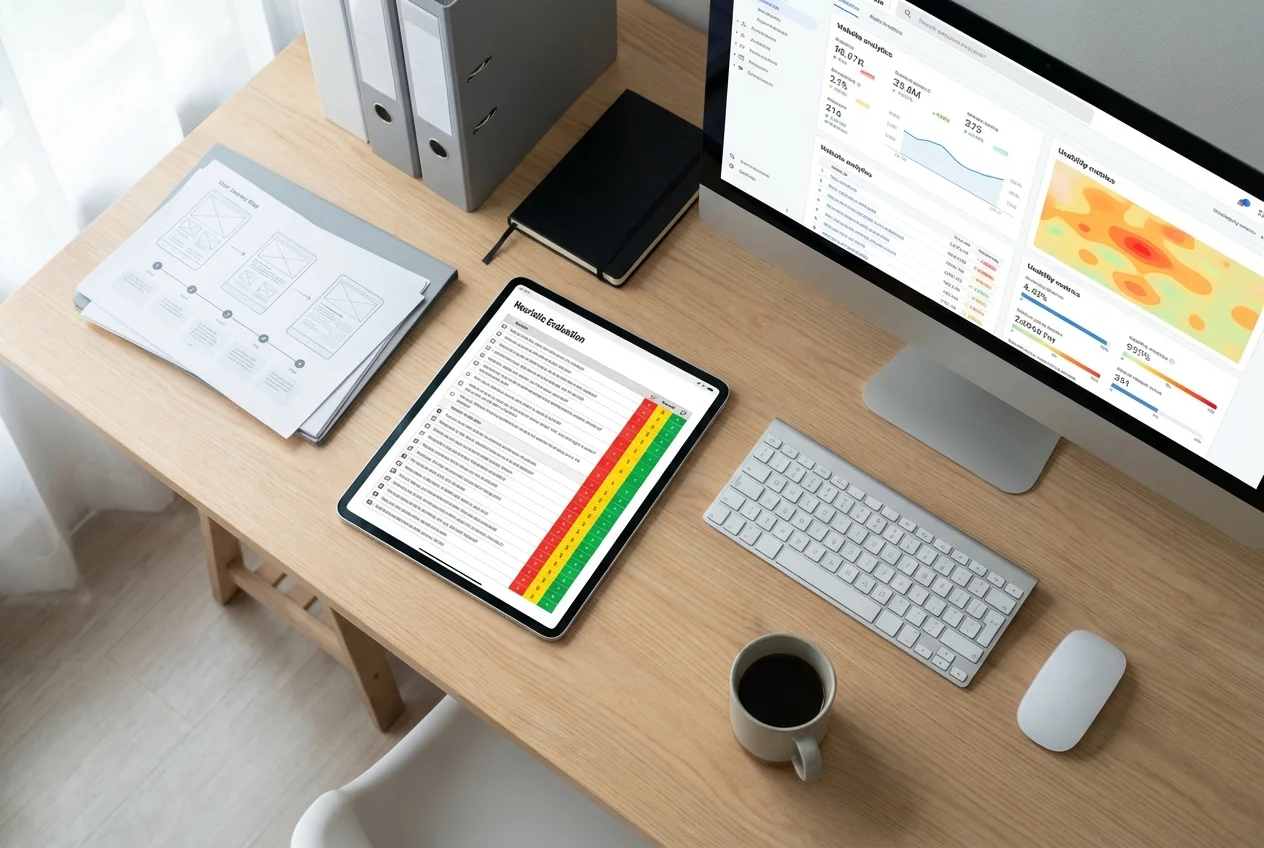
Before commissioning a significant redesign, a diagnostic usability test establishes the evidence base for what to change and why. Redesigns that begin from visual preference or competitive benchmarking consistently underperform redesigns that begin from user evidence. Our UX audit service combines heuristic evaluation with usability testing to produce the most complete diagnostic picture before redesign work begins.
The B2B-Specific Methodology Requirements
B2B usability testing requires a different approach from consumer usability testing, and agencies without dedicated B2B methodology consistently underserve their enterprise clients. The key differences:
Participant Recruitment Is Harder and More Critical
Consumer usability testing can recruit from broad panels. B2B testing requires participants who match the actual professional role using your product — an accounts payable manager using your finance SaaS is not interchangeable with a general office worker, even though both technically "use computers for work". A specialist usability testing agency London maintains recruitment relationships with professional communities and has experience with screeners, incentive structures, and session formats that work for time-pressured B2B professionals.
Tasks Must Reflect Professional Context
B2B users approach software with professional objectives — completing an end-of-month close, processing a client onboarding, generating a compliance report. Usability tasks must be grounded in these real professional contexts, not generic "complete this form" scenarios. Agencies without B2B product experience write tasks that test the interface in isolation; specialist agencies write tasks that test the interface under the conditions of professional use.
Power-User and Novice-User Sessions Must Run Separately
Enterprise B2B products serve both new users (learning the product) and power users (doing complex tasks efficiently). These two populations behave differently and reveal different types of issues. A rigorous ux testing London protocol runs separate sessions for each — then designs for the tension between them, which is the defining hard problem in B2B interface design.
The Severity Matrix Must Reflect Business Impact, Not Just Frequency
A consumer usability agency rates severity by how many users struggle and how much they struggle. A B2B usability agency adds a third dimension: business consequence. An error in a consumer checkout flow costs a sale. An error in an enterprise financial reconciliation workflow costs compliance integrity. The severity taxonomy must reflect this — which means the research team must understand your product's operational context, not just its interface.
How to Evaluate a Usability Testing Agency in London
When assessing London usability testing agencies for a B2B engagement, these questions separate specialist capability from generalist practice:
- Can you show us B2B case studies with named task scenarios and issue taxonomies? Portfolio pieces that show screenshots and testimonials are not evidence. Ask to see actual session guides, severity matrices, and the specific redesign recommendations that resulted from research findings.
- How do you recruit participants matching our professional role? An agency that proposes a generic consumer panel for a professional B2B product does not understand the recruitment challenge. A specialist agency will describe their screener methodology, their professional network relationships, and their approach to incentive structures for time-pressured senior professionals.
- What is your approach to remote versus in-person sessions for enterprise products? Remote testing (via UserZoom, Lookback, or equivalent) offers scheduling flexibility and can access geographically distributed users. In-person testing with eye-tracking offers richer observational data for complex interfaces. A specialist agency will have a considered position on when each is appropriate for your specific product context.
- How do your deliverables integrate with our product backlog? The output of usability research should slot directly into your sprint planning and roadmap prioritisation — not sit in a PDF waiting for someone to translate it into tickets. Ask how the agency formats severity matrices for engineering consumption and whether they attend backlog refinement sessions.
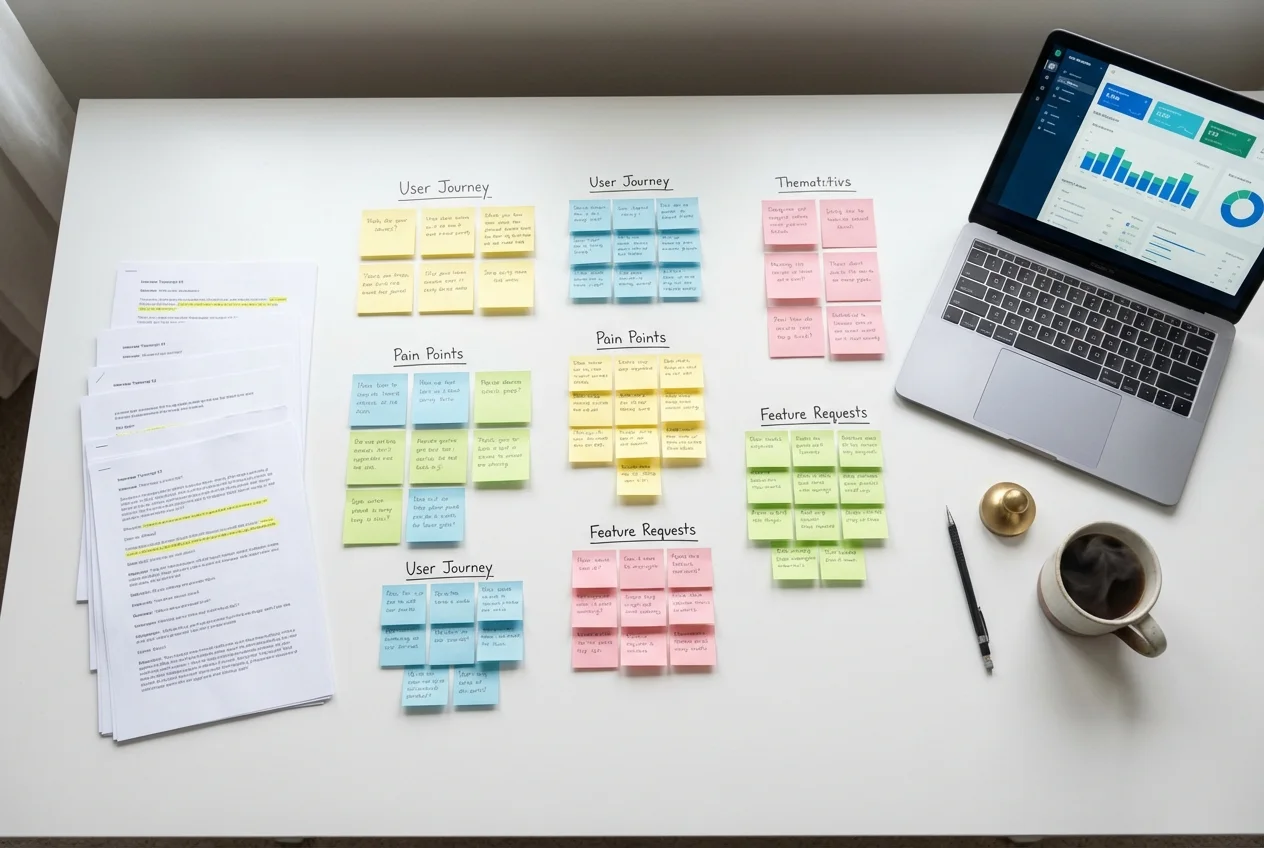
Our UX research service covers the full methodology — from recruitment and session design through to backlog-ready issue reports.
The ROI Case for Professional Usability Testing
The business case for commissioning a professional usability testing agency London team rather than running informal internal testing rests on three measurable outcomes:
Engineering rework reduction. IBM's five-to-ten times cost multiplier for post-build fixes is well established. A typical B2B SaaS usability test at the prototype stage costs £8,000–15,000. If it prevents three significant engineering rework cycles costing £20,000–50,000 each in combined engineering and QA time, the ROI is not a marketing claim — it is straightforward project economics.
Adoption rate improvement. B2B software with demonstrably better usability achieves higher activation rates from trial, faster time-to-value for new accounts, and lower support costs per seat. Each of these metrics is measurable against a pre-engagement baseline, and a professional usability agency can establish that baseline and design the post-launch measurement framework to capture improvement.
Churn reduction. Poor usability is the second most commonly cited reason for B2B SaaS churn after product-market fit issues — and unlike product-market fit, it is directly addressable through design. A single churn prevention at enterprise contract values typically pays for multiple rounds of usability testing.
Combining Usability Testing with UX Strategy
The highest-impact use of usability research is not as a one-off engagement but as an input to ongoing UX strategy. Regular usability testing — quarterly or per major release cycle — keeps the product experience accountable to user evidence rather than internal assumption. When testing findings are integrated with analytics, support ticket data, and NPS trends, the result is a continuous evidence loop that keeps design investment focused on the highest-impact user problems rather than the most visible or most loudly advocated internal priorities.
Our enterprise UX design agency guide covers how usability testing integrates into a full enterprise design programme. For an introduction to the audit-first approach, our UX audit agency London guide explains how diagnostic evaluation and usability testing work together to produce the most complete picture of current product experience quality.
If you are ready to scope a usability testing engagement for your B2B product, book a free 45-minute consultation with our research lead — we will assess your product's current test coverage, identify the highest-priority scenarios to test, and outline a research programme sized to your timeline and budget.
 UX Research
 UX Audit
 UX Strategy